A Good Experimental Album: Michael R. Bernstein, “In A Lost World : A Retrospective 2020-2026” (Soundholes)
By Marc Masters, Good Experimental Music, July 15, 2026
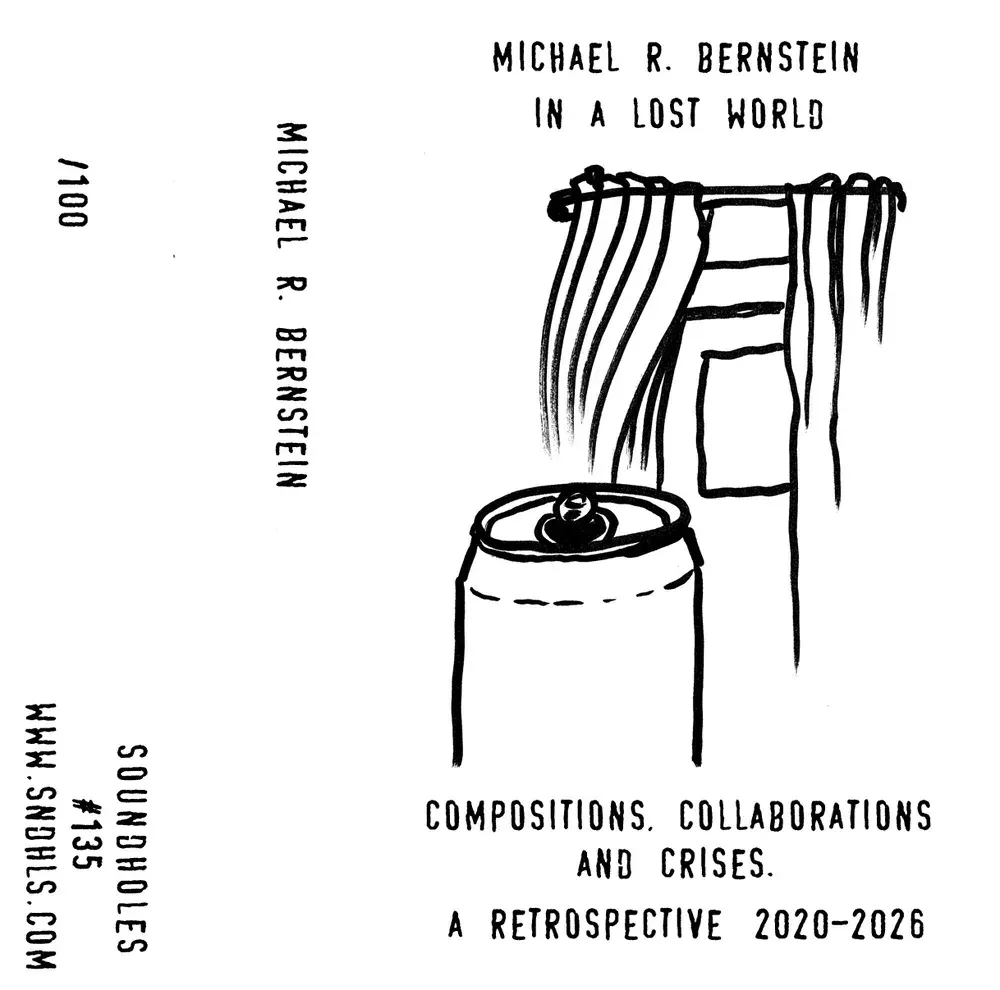
The tape cover for Michael R. Bernstein's "In A Lost World." Illustration by Maya Miller.
When I say I go way back with Michael R. Bernstein, I mean that musically, as a listener and a fan. But I have met him many times too, starting back when I first saw the great 00's noise/drone quartet Double Leopards (check out this 2005 video I shot of them playing at Scott Verrastro's late, lamented 611 Florida Ave. in DC) and tried to snag as much Heavy Tapes stuff as I could, up through encounters with the excellent what-would-you-call-it rock of Religious Knives. Then when he and Maya Miller moved from NYC to the DC/MD line, we would see each other sometimes at Rhizome near their house, or at HR, the great record store he helped co-f0und – but not nearly enough, because the DMV area is perhaps even worse than the five boroughs of NYC when it comes to people struggling to get from one part to the other with any kind of frequency, especially when you both have kids.
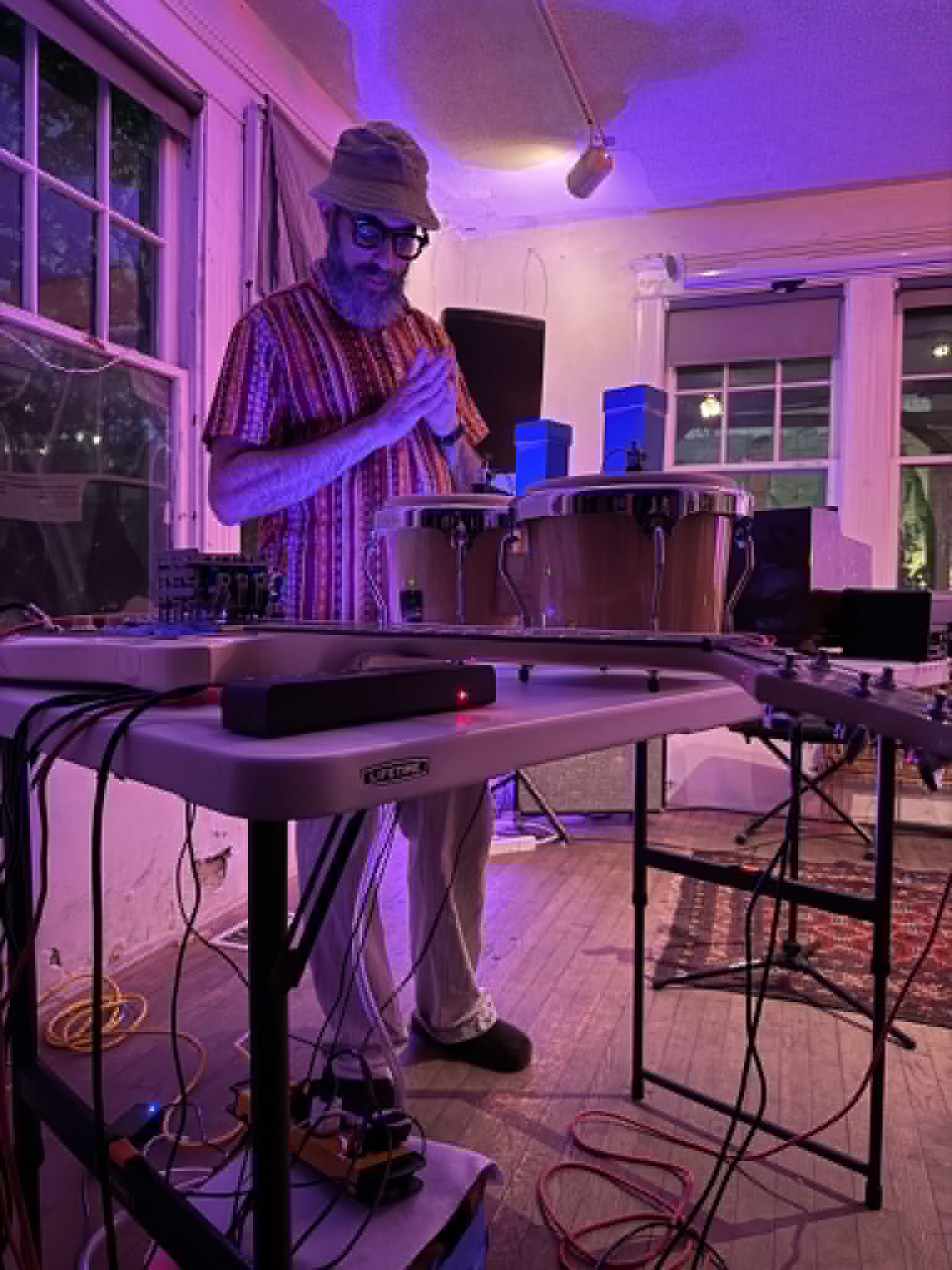
Bernstein at Rhizome in Takoma Park, photo by Maya Miller
But I've tried (and failed) to keep up with everything Bernstein does, which is why In a Lost World, a selection from his solo work of the past six years, is an incredibly welcome thing, filling in some crucial (sound)holes. It also serves as an amazing primer for what he's been doing if you haven't been able to check in at all. What exactly has he been doing? That's even harder to pin down that the work in his previous musical lives, but suffice to say he makes wordless music with software, MIDI, and other processes I don't understand, plus some regular old instruments here and there (a recent Washington Post mini-profile nicely captures Bernstein's current m.o., though you shouldn't read anything else on that site because Jeff Bezos has destroyed it). He does all this in ways that feel both super-conceptual and super-organic, two qualities I don't often hear co-existing so comfortably.
While you listen to In a Lost World, comb through the liner notes in which Bernstein explains the process behind every track, and you might see what I'm getting at. Some of it is conceptual on a level I'll never fully comprehend: one piece, "Sad Sad Birds," is apparently a set of multiple iterations of a previous Bernstein piece passed through some kind of MIDI score software that makes the sound increasingly abstract, while another, "The Perfect Radio Station of the Mind," is an attempt to recreate via originally-written software a Bernstein field recording of a radio, the original of which disappeared when he lost the iPhone with which he captured it. There's also stuff here whose origins are easy to picture, such as "Vibration," a collaboration with Miller made while the two were prepping dinner for their kids.
The results of these varied processes, trials, and improvisations are unfailingly active and attention-grabbing. And sonically they touch on an impressively wide range of tones, tempos, and relations to musical convention. In a Lost World proceeds chronologically; the earliest material is actually in the vicinity of dance music, particularly the hand-clapping/bell-ringing "Biblical Times." As the calendar and the album move forward, things start to float, dissolve, mystify, and enchant. "Flying, Sweet Earth (For Marion Brown)" cycles keyboard figures into a kind of smooth-listening space transmission; "I & I & I & I" pulses skyward while depositing trebly sparks in its wake; "Sensing / Sending (Live at Rhizome)" is all stuttering, oblongly-looped percussion crafted again via bespoke software, Ableton, MIDI, and so forth.
Reducing the sequence of tracks on In a Lost World down to a progressive, traceable arc is oversimplifying it, though. Bernstein's ideas and all the various planned and random effects borne from them don't hew to a definable sonic philosophy or even one train of thought. Though it's clear he put time, and work into everything here, these strike me as true experiments, in the sense that there's a steady, coursing curiosity about what will happen when he follows an idea. Maybe that's a definable philosophy on its own; if so, it's one common to Bernstein's decades of sonic adventuring. In other words, you might not guess when you were watching Double Leopards kneeling over pedals making drones that someday he'd be writing software to make music (though for all I know he kneels over his laptop when he's coding). But the wonder and the courage to try things has always been there.
Which makes closer "Slow Wind," taken from a solo guitar release that he put out just last December, an oddly apt finale. Weaving and winding string sounds into a bending geometric shape, he sounds like he's far away from any computer, software, or bits and bytes of any kind (there actually is a lot of all that behind the piece, once again in a way I don't understand), rather just a guy and a guitar, making sounds that matter.
Published with the permission of the author. Sign up today at goodexperimentalmusic.com.